

 By
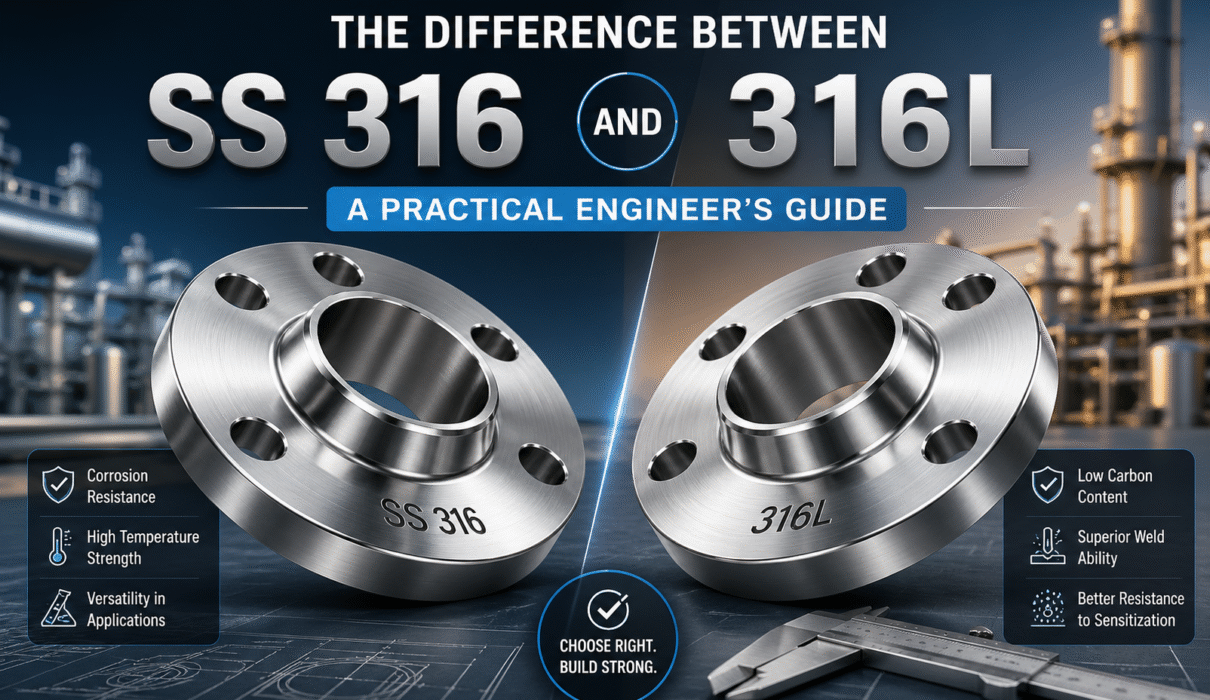
By In industrial piping systems, selecting the right flange material is essential for ensuring long-term performance, corrosion resistance, and operational safety. Among the most widely used stainless steel flange materials are SS 316 and SS 316L. While these two grades may appear similar at first glance, their differences can significantly impact performance in certain applications.
For engineers, contractors, and procurement teams, understanding the practical differences between SS 316 and 316L flanges helps ensure better material selection for specific operating conditions.
Understanding SS 316 Stainless Steel
SS 316 is an austenitic stainless steel grade containing chromium, nickel, and molybdenum. The addition of molybdenum improves corrosion resistance, especially against chlorides and harsh industrial chemicals.
SS 316 flanges are widely used in:
- Chemical processing plants
- Marine environments
- Food processing industries
- Pharmaceutical manufacturing
- Heat exchangers
- Offshore applications
They offer excellent strength, durability, and resistance to corrosion in demanding environments.
What Is SS 316L?
SS 316L is the low-carbon version of SS 316. The “L” stands for “low carbon,” meaning the material contains a lower carbon percentage compared to standard SS 316.
This lower carbon content helps reduce carbide precipitation during welding, which improves corrosion resistance in welded areas.
SS 316L flanges are particularly preferred in applications involving extensive welding or highly corrosive environments where weld integrity is critical.
The Main Difference: Carbon Content
The primary distinction between SS 316 and SS 316L lies in their carbon composition.
- SS 316 typically contains up to 0.08% carbon
- SS 316L contains a maximum of 0.03% carbon
Although this difference seems small, it plays a major role in weldability and corrosion resistance after fabrication.
Lower carbon levels in SS 316L reduce the risk of sensitization, a process where chromium carbides form at grain boundaries during welding, potentially weakening corrosion resistance.
Corrosion Resistance Comparison
Both SS 316 and SS 316L offer excellent corrosion resistance, particularly in chloride-rich and chemical environments. However, SS 316L generally performs better in welded structures and highly corrosive applications.
SS 316L flanges are often preferred in:
- Pharmaceutical systems
- Marine piping
- Chemical transport lines
- High-purity processing systems
The improved resistance to intergranular corrosion makes SS 316L especially valuable in critical sanitary and corrosive applications.
Weldability and Fabrication
Weldability is one of the biggest practical considerations when selecting between these two grades.
SS 316 can be welded successfully, but welded areas may require post-weld heat treatment in certain environments to restore corrosion resistance.
SS 316L, on the other hand, offers superior weldability because its lower carbon content minimizes carbide precipitation during welding.
For projects involving extensive fabrication or field welding, engineers often choose SS 316L flanges to simplify installation and improve long-term durability.
Strength and Mechanical Properties
SS 316 generally offers slightly higher tensile and yield strength compared to SS 316L because of its higher carbon content.
However, the strength difference is relatively minor for most industrial applications.
In practical engineering scenarios:
- SS 316 may be selected where slightly higher mechanical strength is required
- SS 316L is typically preferred where corrosion resistance and weldability are more important
The choice depends on balancing mechanical performance with environmental exposure and fabrication requirements.
Temperature Resistance
Both SS 316 and SS 316L flanges perform well across a wide temperature range and are suitable for high-temperature industrial environments.
However, SS 316 may provide slightly better high-temperature strength due to its higher carbon content.
For continuous elevated-temperature service without significant welding concerns, SS 316 may sometimes be preferred.
Common Industrial Applications
SS 316 Flanges Are Commonly Used In:
- High-temperature systems
- Industrial processing plants
- Pressure vessels
- Heat exchangers
- Structural piping systems
SS 316L Flanges Are Commonly Used In:
- Pharmaceutical industries
- Food processing plants
- Marine applications
- Chemical industries
- Hygienic and sanitary systems
- Weld-intensive projects
Understanding the operating environment helps engineers determine the most suitable flange grade.
Cost Considerations
The cost difference between SS 316 and SS 316L flanges is usually minimal. However, SS 316L may sometimes be slightly more expensive because of its specialized low-carbon manufacturing process.
Despite this, many industries consider the added corrosion protection and welding advantages of SS 316L worth the investment, especially for long-term operations.
Which One Should You Choose?
The decision between SS 316 and SS 316L flanges depends primarily on:
- Welding requirements
- Corrosive exposure
- Operating temperature
- Mechanical stress
- Industry standards
- Maintenance expectations
Choose SS 316 when:
- Slightly higher strength is needed
- Welding exposure is limited
- High-temperature performance is a priority
Choose SS 316L when:
- Extensive welding is involved
- Corrosion resistance is critical
- Hygienic applications are required
- Long-term weld durability matters
Final Thoughts
Both SS 316 and SS 316L flanges offer excellent performance for industrial piping systems, but understanding their differences is essential for making the right engineering decision.
While SS 316 provides strong mechanical performance and reliable corrosion resistance, SS 316L stands out for its superior weldability and enhanced protection against intergranular corrosion.
By carefully evaluating operating conditions, fabrication requirements, and long-term performance goals, engineers can select the most suitable flange material to ensure efficient, safe, and durable industrial operations.